
Two proposals in front of NASA right now.
The same passive augmentation layer answers two separate NASA calls — one for contingency crew mobility, one for electrostatic discharge. Both because a system with no power draw and no emitter behaves the same on the lunar surface as it does in a stairwell.
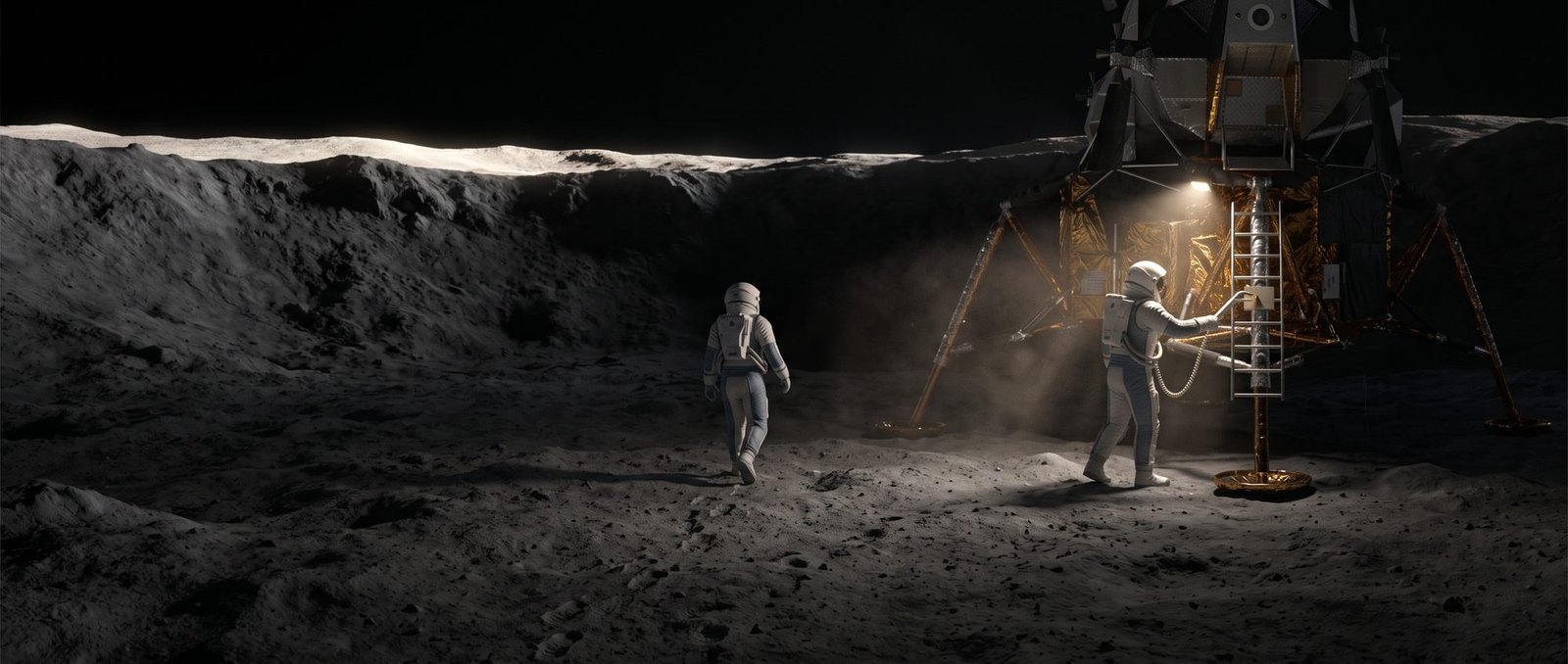
Moon Base — Passive Mobility Augmentation
Submitted to the NASA Moon Base collaboration call under mobility and human surface operations. A passive wearable layer that lets a crew member cover ground unassisted when rovers and drones cannot reach them. Leaf-spring joints give 2–2.5× range gain over unassisted lunar movement at 35–45 m per bound; 600 m closes in 15–20 assisted strides rather than a 20–30 minute EVA shuffle. It attaches at the arm-torso junction and leg channels already present in hard-shell upper torso designs — no pressure system integration, no power connection.
Read the Offworld programme →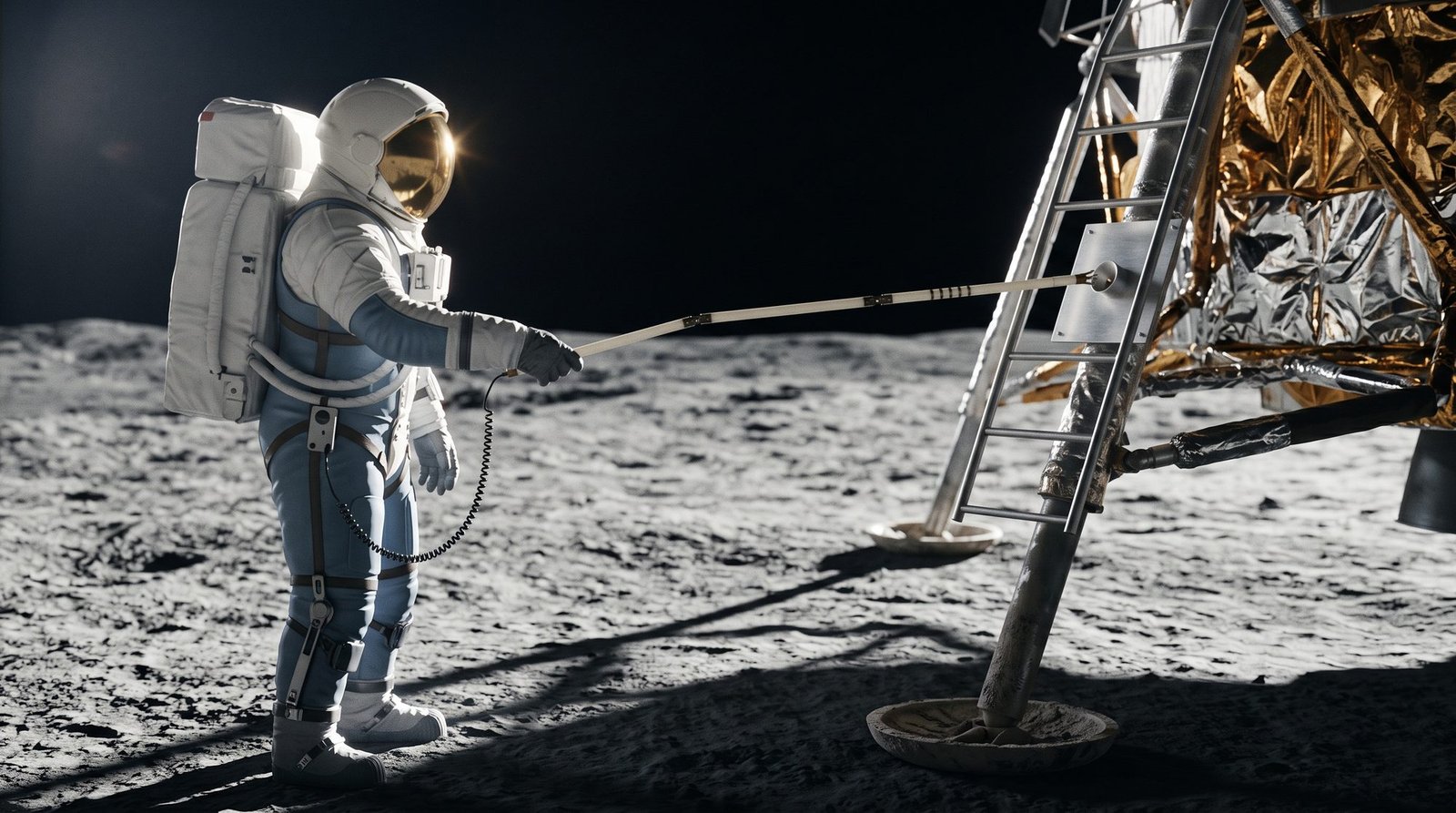
GroundSkin — Lunar Grounding Challenge
A NASA Tournament Lab challenge on electrostatic discharge mitigation. Our concept integrates charge management into the mobility layer the astronaut already wears. A passive folding discharge wand carries four 250 MΩ resistors that hold the full high-voltage drop 866 mm away from the glove, paired with a dissipative outer-layer coating and a lander-mounted target plate. The design deliberately rejects three approaches that fail on inspection — corona emission does not behave as advertised in vacuum, cold regolith conducts too poorly to serve as a ground, and a chest-mounted connector would arc onto the pressure garment.
Submission detail →Concept narrative, the nine-sheet dimensioned drawing set, the mobility-layer appendix, and a supplemental archive carrying the Python model that reproduces every number in the electrical analysis.
Four markets. One passive platform.
We organise the company around the people who benefit, not the animals we borrowed from. The biology is how we get there — and it genuinely holds the interesting part — but a fire captain does not need a lecture on gecko setae to understand a suit that climbs a wall without a rope.

Capability at zero charge.
Special operations, urban search and rescue, structural and CBRN response. Silent adhesion that ascends a building without anchors. Leaf-spring joints that clear a wall without a ladder. Helicoidal armour that needs 70% more energy to crack. Nothing carries a duty cycle, so nothing fails flat.
Explore this market →
Therapy that never needs charging.
AMRS — the Adaptive Meridian Resonance Suit. Triboelectric nanogenerators woven into high-flexion zones turn the wearer's own gait into therapeutic current, routed along the fascial planes that measure lowest in tissue impedance. Six garments across sarcopenia, stroke rehabilitation, Parkinson's, neuropathy and dementia.
Explore this market →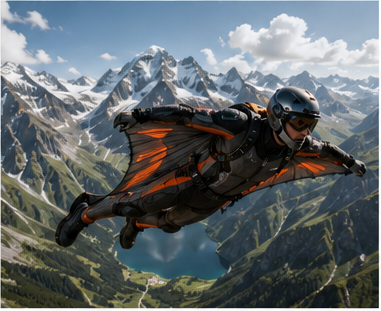
The ceiling was the fabric, not the athlete.
Wingsuit glide ratio sat at 3:1 for a decade because nobody applied fluid dynamics to full-suit geometry. DragonSuit targets 5–6:1. GripSuit puts gecko adhesion on glass and clingfish compliance on rock. JumpSuit returns 97% of stored energy at the ankle. Entry pricing starts at $279.
Explore this market →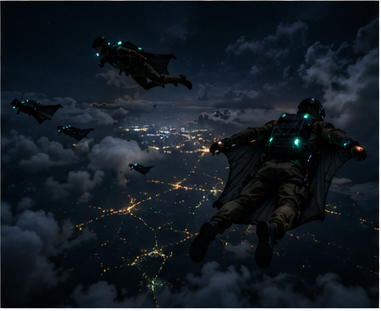
When the rover isn't coming.
A passive augmentation layer for lunar and Martian surface operations. Leaf-spring joints deliver 2–2.5× range gain and 35–45 m bounds at one-sixth gravity; the wing survives vacuum not as a lift surface but as ballistic attitude control. 4.5–6 kg, no power, no pressure-system integration.
Explore this market →Five wearable systems, one materials stack.
The same riblet film, auxetic panel and shape-memory skeleton recur across products because each one solves a physics problem that shows up in more than one market.
DragonSuit
Five-layer biomimetic composite wingsuit — shape-memory polymer rib skeleton, auxetic self-cambering panels, humpback tubercle leading edge, shark riblet film, peregrine tip slots.
Technical detail →GripSuit
Four adhesion mechanisms in one zone-selective pad: gecko van der Waals nano-pillars, clingfish compliant disc lip, remora lamellar spinules, DOPA-mimetic mussel chemistry.
Technical detail →JumpSuit
Carbon-fibre leaf-spring joints at ankle and knee with a bistable snap-through latch, modelled on insect resilin at 97% elastic return.
Technical detail →AquaSuit
Boxfish ridge geometry for passive yaw stability plus a water-strider superhydrophobic plastron cutting swim drag an estimated 30–40%.
Technical detail →AMRS
Self-powered therapeutic garments: triboelectric harvesting, anatomically-routed stimulation, vibroacoustic nodes and nacre-analog mechanical assist in a 2.4 mm textile stack.
Technical detail →Passive is not a limitation. It holds the specification.
Nothing to charge
The largest failure mode in wearable technology never involves efficacy. People simply stop charging the device. A passive system has no charge state to fail into — a spring stays a spring at 3 a.m. on day 400.
Nothing to detect
No emitter means no signature. That matters to an operator avoiding detection and equally to a patient who wants a garment rather than a medical device with a radio in it.
Nothing to break
Actuators seize, servos strip, control loops desynchronise. Material behaviour does none of that. Every mechanism here performs through geometry and composition, not because software tells it to.
Every organism we borrow from faced the same constraint set. No gecko carries a battery. No falcon runs a control loop. Four billion years of selection pressure produced an enormous library of solutions that work on material physics alone — exactly the library you want when the specification says the system must work at zero power, in the dark, with no maintenance. See how the method works →
Read the actual engineering.
Full technical proposals rather than marketing summaries — including the sections where we state plainly what nobody has validated yet.
Physics first. Materials second. Geometry last.
DragonWorx Biomimetic Technologies operates as a deep-tech company in Richardson, Texas. We design in the reverse of conventional practice: the physics requirement comes first, material selection second, and the shape of the product last. That order explains why a wingsuit ends up with a shape-memory polymer skeleton and a therapeutic garment ends up harvesting its own power — in both cases the material got chosen to solve a stated physical problem, not to fit a product already sketched.
We publish our research proposals in full, including the sections that state where the evidence runs thin. We label every performance figure as either a validated result or a design target pending experimental work. We currently raise a $1.8M seed round to fund wind tunnel validation at UT Arlington, materials characterisation at UT Dallas, and first-article fabrication.
Procurement, clinical partnership, research collaboration, investment or athlete programmes — all
reach the same inbox.
getdragons@dragonworx.bio
· Richardson, Texas