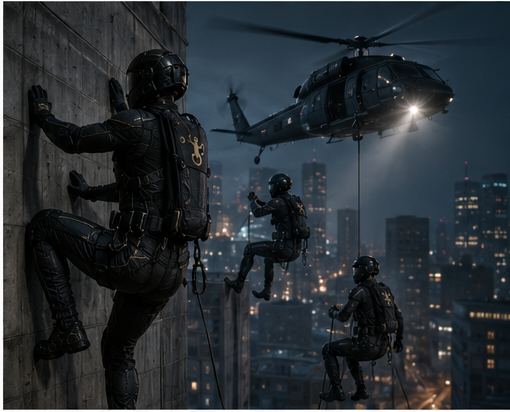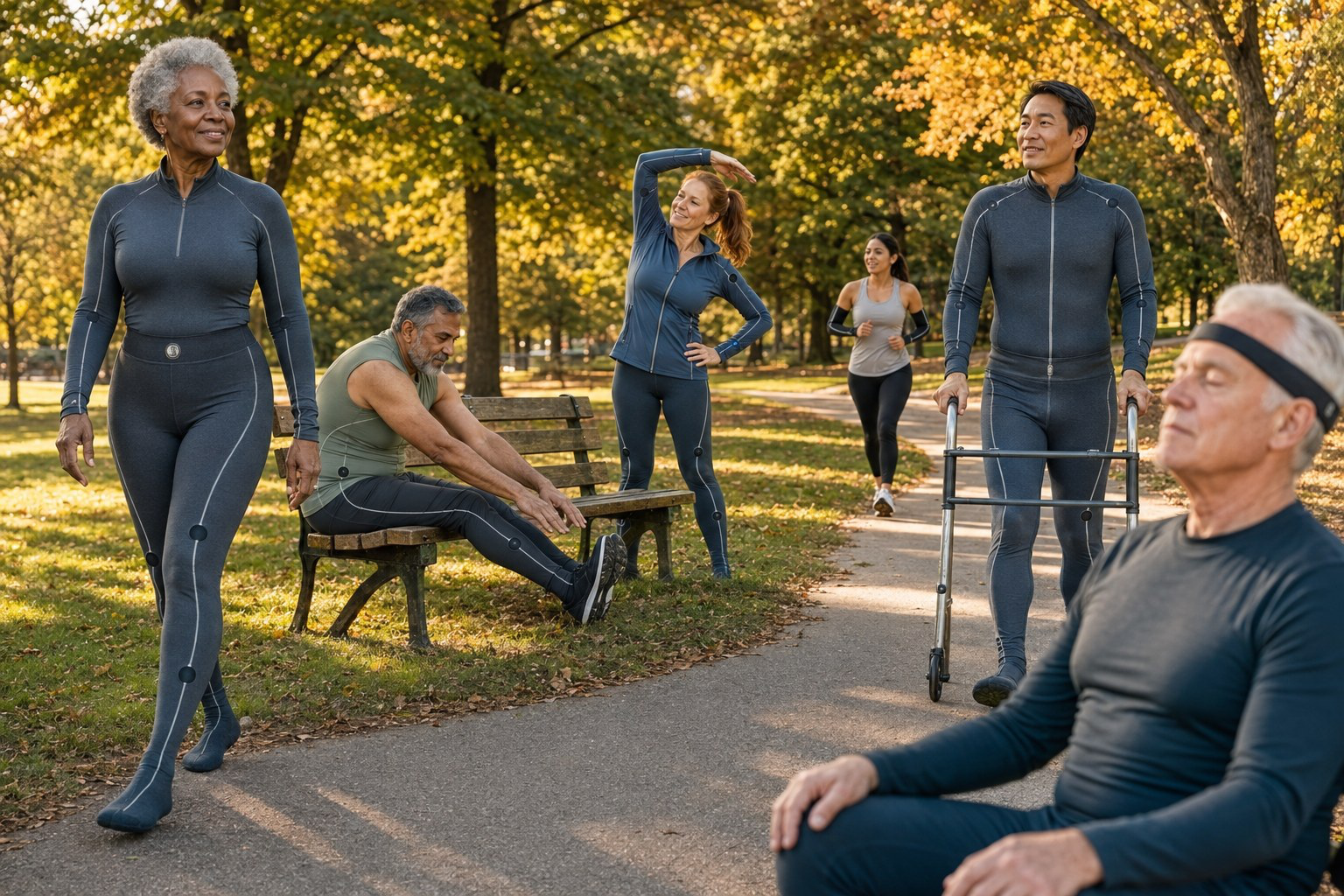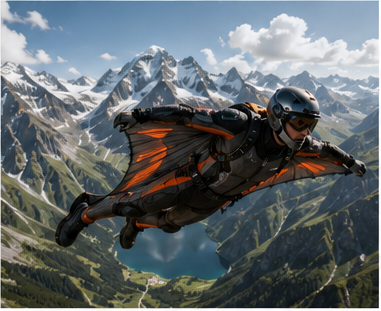
An operator in a dark stairwell. A stroke patient six months into rehabilitation. A wingsuit pilot at terminal velocity. A colonist 600 metres from an airlock. Four very different people, one shared constraint — and one materials platform built around it.
We organise the company around the people who benefit, not the animals we borrowed from. The biology is how we get there — and it is genuinely the interesting part — but a fire captain does not need a lecture on gecko setae to understand a suit that climbs a wall without a rope.

Special operations, urban search and rescue, structural and CBRN response. Every platform is passive by design — silent adhesion that ascends buildings without anchors, leaf-spring joints that clear a wall without a ladder, helicoidal armour that needs 70% more energy to crack. Nothing has a duty cycle, so nothing fails flat.
Explore this market →
AMRS — the Adaptive Meridian Resonance Suit. Triboelectric nanogenerators woven into high-flexion zones convert the wearer's own gait into therapeutic current, routed along the fascial planes that measure lowest in tissue impedance. Six garments across sarcopenia, stroke rehabilitation, Parkinson's, neuropathy and dementia. No battery means no compliance burden.
Explore this market →
Wingsuit glide ratio sat at 3:1 for a decade because nobody applied fluid dynamics to full-suit geometry. DragonSuit targets 5–6:1. GripSuit puts gecko adhesion on glass and clingfish compliance on rock. JumpSuit returns 97% of stored energy at the ankle. Entry pricing starts at $279.
Explore this market →
A passive augmentation layer for lunar and Martian surface operations. Leaf-spring joints deliver 2–2.5× range gain and 35–45 m bounds at one-sixth gravity; the wing survives vacuum not as a lift surface but as ballistic attitude control. 4.5–6 kg, no power, no pressure-system integration. Submitted to the NASA Moon Base collaboration call.
Explore this market →The largest failure mode in wearable technology is not efficacy. It is that people stop charging the device. Passive systems have no charge state to fail into — a spring is a spring at 3 a.m. on day 400.
No emitter means no signature. That matters to an operator avoiding detection and to a patient who simply wants a garment rather than a medical device with a radio in it.
Actuators seize, servos strip, control loops desynchronise. Material behaviour does not. Every mechanism here performs because of geometry and composition, not because software is telling it to.
Every organism we borrow from faced the same constraint set. No gecko has a battery. No falcon runs a control loop. Four billion years of selection pressure produced an enormous library of solutions that work on material physics alone — which is exactly the library you want when your design specification says the system must work at zero power, in the dark, with no maintenance. See how the method works →
Full technical proposals, not marketing summaries — including the sections where we state plainly what has not been validated yet.
DragonWorx Biomimetic Technologies is a deep-tech company in Richardson, Texas. We design in the reverse of conventional practice: the physics requirement comes first, material selection second, and the shape of the product last. That order is why a wingsuit ends up with a shape-memory polymer skeleton and a therapeutic garment ends up harvesting its own power — in both cases the material was chosen to solve a stated physical problem, not to fit a product that had already been sketched.
We publish our research proposals in full, including the sections that state where the evidence is thin. We label every performance figure as either a validated result or a design target pending experimental work. We are currently raising a $1.8M seed round to fund wind tunnel validation at UT Arlington, materials characterisation at UT Dallas, and first-article fabrication.
Procurement, clinical partnership, research collaboration, investment, or athlete programmes — all reach the same inbox. getdragons@dragonworx.bio · Richardson, Texas.